
Author Archives: Darragh McManus

Well hello, Stranger

This is a (long) article I wrote for the paper a while back, which unfortunately wasn’t published in the end…so I’m sticking it up here. Now read on…


The youthful rebel without a cause is one of the most enduring icons of our culture. Think Holden Caulfield lambasting “phonies” in Catcher in the Rye, Marlon Brando scorching the screen in The Wild One, gloomy Raskolnikov in Crime and Punishment, or Kurt Cobain’s self-hating screeds during Nirvana’s glorious reign.

There are many more, of course, but perhaps the king of them all is Mersault, anti-hero of The Outsider (L’Étranger). Albert Camus’ 1942 novel concerns a young man shunned by bourgeois society for shooting an Arab dead on a sun-bleached beach; and worse, seeming to express no remorse over it, and worse again, not mourning his mother in a public and melodramatic way.

The Outsider – perfect title too – is perhaps the classic tale of youth in revolt: disaffected, alienated, rebelling against society’s norms, inscribing one’s own meaning onto a meaningless universe…or maybe just being contrary for the sake of it. The ambiguity is part of the beauty.

What makes these characters and stories so fascinating? And what makes most of us go through a youthful period of rebellion, alienation and reckless adventure?

We’ll take the second question first. Dr Carl Pickhardt is a Harvard-educated Texan psychologist specialising in children and adolescents. His 15 books include Surviving Your Child’s Adolescence, he writes a blog for Psychology Today on the subject, and he’s appeared in Time, The Wall Street Journal and a host of Stateside TV shows.

Rebellion and alienation, he says first, are not the same. “Rebellion is an act of resisting the adult powers-that-be, and the rules of authority they represent. Alienation is an act of withdrawal in order not to be part of the status quo or support the social norm. For example, some alienated adolescents can decide to drop out, operate on the fringe and not socially participate; while some rebellious adolescents, carrying the banner of personal freedom, can buck the system at home, at school, out in the world. In this sense, rebellion is more opposition-based, and alienation is more estrangement-based.”

Crucially, both rebellion and alienation have a purpose during adolescence. Dr Pickhardt says, “Adolescence is that process of transformation which begins around ages 9-13 and usually winds down in the early- to mid-twenties. Over the course of this trial-and-error growth the child becomes a young adult. Both rebellion and alienation have roles to play.

“The twin goals of adolescence are independence and individuality. In service of these outcomes some degree of rebellion and alienation has a healthy part to play, so long as the young person does not engage in self-defeating, self-destructive, or socially harmful behaviour.

“Early adolescence begins with the separation from childhood; in words and actions the young person is declaring that they no longer want to be defined and treated as just a child anymore. Now rebellion starts the push to operate more on one’s own terms by pushing against adult, particularly parental, authority: actively, through argument and disobedience, and passively, by ignoring and delay.

“Alienation is the withdrawal from family to join a competing social family of peers who are all in the business of becoming different in the same way he or she is. What’s important to understand here is that parents are neither destined nor obliged to go through agony with their adolescent, since in most cases the process unfolds within the tolerance limits of a well-functioning family life.”

A different view – less medically professional perhaps, more creatively intuitive – comes from Julian Evans, author of three books and a literary critic and broadcaster with a special interest in the development of the modern novel. An Académie Française laureate, he’s currently making a new translation of André Gide’s 1914 classic of existential angst, The Vatican Cellars.

Julian believes that “every new generation kicks against both the conventions of their parents’ generation and the more embedded, more political, society-moulding conventions of the deeper status quo”.

And this helps explain why we’re drawn to “the heroes and anti-heroes who express that revolt – Mersault and Lafcadio, stars like Brando and Dean and the characters they played, and the early-dead of rock’s pantheon, performers like Janis Joplin, Kurt Cobain and Amy Winehouse.

“Their attraction is that they’re against something we know is fatally compromised because, apart from anything else, it threatens to bore us to death: the life-path that society – with all its vested interests, repressions and mediocrity – lays down for us. The fact that most of us eventually compromise, or come to terms to some extent, with that life-path and society is, well, another interesting aspect of existence. And of course society needs some sort of system to function.

“But not all of us compromise to the same degree. Some keep on rebelling, or at least resisting.”

He cites, as the most seminal rebels or outsiders in fiction, Mersault, Holden Caulfield, Gide’s Lafcadio, the nameless narrators of Dostoyevsky’s Notes from the Underground and Michel Houellebecq’s Whatever, Don Quixote, Huckleberry Finn and William Brown.

Their motivations – much like in life, really – are manifold, Julian says: “Societal repression, especially in adolescence; dysfunctional materialism in American Psycho; hypocrisy, convention and boredom, for example in The Vatican Cellars, Sartre’s Nausea or Houellebecq’s Atomised. The characters in all these are falling or fallen, and most want to break out or to stop falling in any way they can.

“They’re usually cursed with a burden of self-consciousness and seek self-forgetfulness or every sort of consciousness-oblivion: joy, love, drugs, murder. They want to change the world and forget themselves. Consciousness is a heavy load.”

UCD graduate Peter Francev is president of the Albert Camus Society USA and editor-in-chief of The Journal of Camus Studies. He now lectures at university at southern California, and is a PhD candidate at the University of Leicester for research on Byron and hermeneutics (the theory of textual interpretation).

Mentioning Meursault, Joyce’s Stephen Daedalus and – that boy again – Holden Caulfield as classic outsiders, Peter adds, “The moody outlaw represents what most of crave to be, at one point or another in our lives. It is the idea that we don’t necessarily care about much of anything, including ourselves. And since this individual seems to go against the norm of society, he or she is viewed as a rebel.

“These characters’ motivations depend upon the author or book, but generally I would say that it is not merely the idea of rebellion, but the idea of ineptitude regarding an emotional connection with society. Also, it could be rooted in someone not feeling as if they’re fitting in with society.”

It’s not all bratty awkwardness and anti-social destructiveness; there can be a great positive power in these stubborn outsiders, and what they represent. “I don’t see much of a positive side to Bret Easton Ellis’s protagonists,” Julian says, “but anyone who is against the status quo has potentially got something positive to say. Most writers would say that ‘writing against’, and inventing characters who ‘act against’, are positive things for an artist to do.

“Perhaps one of the reasons Camus is being talked about again is that we’re clinging to the remnants of a political, economic and moral orthodoxy that has less and less to say to us. Federico Fellini said, near the end of his life, something like: ‘We know something is coming, but we don’t know what. Fascinated and mixed-up in the present, we are living in a sort of waiting-room.’ That inertia and apathy has to be challenged – and the young in particular have the energy to do it.”

Dr Pickhardt says, “In the larger social scheme of things, social reform can depend on people opposing or withdrawing from the existing system of governance. So rebellion and alienation are things that adults experience as well as adolescents, but for young people they are built into the process of growing up.

“I believe the outlaw, in song and other story forms, represents the alienated outsider who is resolved to live individually and independently, according to his or her rebellious rules. This is an inspiring image for adolescents and a romantic one for those adults who, in the process of making a living and managing a family, may feel like they comply and conform more than they wish.”

Ah, there’s the rub: age. We almost always speak of these things in terms of “growing up” and “gaining” maturity in sloughing off all that youthful angst. Could it be the case, though, that we’re not just gaining something, but losing something? Should we hold onto those feelings of alienation or rebellion? And is it possible that we regret that loss, even subconsciously, as our life goes on?

“Growing up is giving up,” Dr Pickhardt says. “Just as the girl or boy must give up some valued childhood ways to become adolescent, so the young person has to give up some adolescent ways to become adult – becoming part of the established system, for example, rather than opposing and withdrawing from it. But older adults may still envy the adolescent who feels free to act in the rebellious and alienated ways they remember in their youth, but can no longer afford to do.”

Julian says, “The jury’s out, to my mind, on whether adulthood is about gaining maturity or losing the spirit of revolt. Experience tells me that most people, as opposed to fictional characters, do lose their spirit of revolt and either make their peace with the power structure or become ‘rebellocrats’: one-time enfants terribles who keep the mannerisms but align themselves with the power structure.

“Bertolt Brecht – who was not a rebellocrat in my view – once said there were two kinds of anger: ‘small anger’, or kleiner Zorn, and ‘big anger’, or grosser Zorn. Small anger is weak and temporary; the bigger sort is the rarer, truly artistic kind. I think it’s a useful distinction. More people have kleiner Zorn than have grosser Zorn. But José Saramago, for instance, held on to his anger he’d had as a young communist and remained a member of the Portuguese Communist Party until his death.”

And existential heroes in fiction aren’t always young, he points out: he mentions “José Saramago’s potter, Cipriano Algor, rebelling against the tide of shopping-mall materialism in The Cave; or Querry in Graham Greene’s A Burnt-Out Case.” So maybe there’s some hope for us oldies yet, to keep those rebel fires burning.
Julian says: “Perhaps in the best outcome, the spirit of open revolt gives way, as we become older adults, to a spirit of resistance. I definitely feel we should hang on to our feelings of alienation, and continue to know when to rebel, even as we learn to accommodate ourselves to the world. Increasingly all around us are circumstances and conventions trying to stop us being free. Get a job! Earn a living! Work for less! Do what you’re told! Resistance these days is a condition of keeping hold of our freedom.”

Peter adds, “With age comes maturity, more or less. Once the idealised novelty of rebellion wears off, the rebel settles down into a life of routine. Take Camus’ oeuvre, for example. One could make the argument that had Meursault been acquitted of murder – and being a bad son – then he could have taken the job in Paris and even gone into law. Of course, he would have despised law and may have fled to Amsterdam like Camus’ later protagonist Clamence.

“But our youthful experiences help shape who we are, and who we become as adults. When we lose those feelings of rebellion, a part of us dies, and there is the sorrow of an innocence lost.”

Sorrow, death, loss: Mersault and the rest, you feel, would have at least understood, if not approved.


PANEL #1:

“The outsider carries aspects of our shadow selves, our darker instincts”

Outsiders are the bearers of uncomfortable truths. Camus said Meursault is condemned because he refuses to lie – society demands that he weep at his mother’s funeral and regret his crime, but he won’t play the game. We don’t want to be Meursault but we’d like that ability to detach, to stand apart and take a stance when our beliefs don’t accord with the mainstream. The outsider carries aspects of our shadow selves too, our darker instincts, like the scapegoat in Biblical times. They act as a kind of sublimator of those inadmissible thoughts and urges we all possess but daren’t express.

When it comes to fiction, happiness writes white. A character devoid of some subterranean pull, some inner wrestling with the meaning of existence, simply isn’t interesting. In fiction, as in life, we’re drawn to those who share our sensations. Who, among us, has not pondered on the reasons we’re adrift in this earthly space? Who at the fall of evening has not been gripped by a sudden fear of death and the unknown?

Everything seeps into fiction. Writers and artists are always tapping into changes and disturbances in the collective. The great shifts in consciousness induced by Darwin, Nietzsche and Freud were being felt in the early twentieth century, as morality and conscience were decoupled from the divine.

The last century witnessed two world wars, the death camps, the Bomb, ethnic cleansing, chemical warfare, systematic torture: in the face of such stupefying evil is it any wonder feelings of alienation and dread surfaced – and continue to – in fiction? In the past, religious belief offered a promise of salvation, but in an indifferent universe with no hope of an afterlife, characters are compelled to search within for the meaning for their existence, reflecting man’s painful push towards individuation.

For me, the greatest living exponent of philosophical fiction is JM Coetzee. In The Life and Times of Michael K he created Meursault’s natural heir. With his Kafkaesque lineage Michael K is the quintessential outsider. Mute, hare-lipped, devoid of material trappings or gifts of the intellect, he leaves the city and roams the desert. Psychically naked, he is repeatedly incarcerated and, though nearing death, still refuses to eat, speak or surrender to the system.

Coetzee also provides us with some of the best examples of older characters, especially female, wrestling with existentialist angst. And in the company of his greatest creation, the elderly Elizabeth Costello, there is no shelter from the self and no shirking of awkward truths. She cogitates on life, death, lack of hope, the end of history. So while rebellion may be synonymous with angry young men eager to start a revolution, existentialist angst in literature is by no means confined to the young.

  • Mary Costello’s collection of stories, The China Factory, was published in 2012. The Galway writer’s first novel will be published in November.


PANEL #2:

Youthful alienation, rebellion and outlaws – the best books…

  1. The Outsider, Albert Camus – I’m alive, I’m dead, I’m the stranger, killing an Arab
  2. A Clockwork Orange, Anthony Burgess – Burgess’ unique confection of moral treatise and linguistic pyrotechnics is still spectacular to read today
  3. The Catcher in the Rye, JD Salinger – how not to make friends and influence people…but at least you won’t be a phony
  4. The Vatican Cellars, André Gide – a nihilistic, amoral anti-hero is still some kind of hero
  5. The Prodigy, Herman Hesse – the straightjacket of formal education sees a gifted boy lose his mind
  6. The Outsiders, SE Hinton – gang-fights in 1960s Oklahoma, written when Hinton was just 15
  7. The Growing Pains of Adrian Mole, Sue Townsend – we thought it was all laughs as kids, not realising how downbeat the book really was
  8. Brighton Rock, Graham Greene – Pinkie is a terrifyingly believable teenage psychopath
  9. Less than Zero, Brett Easton Ellis – the first in a career full of books centred on self-absorbed brats, over-consumption and trendily flat prose
  10. Lord of the Flies, William Golding – brilliant, sad story of public school boys turning feral on a tropical island

…and films:

  1. Rumblefish – another Hinton story, made into elegant, abstract cinematic art by Francis Ford Coppola
  2. West Side Story – so which are you, a Jet or a Shark?
  3. Battle Royale – seminal Japanese shocker about a class of students let loose on an island to kill each other. Presumably inspired The Hunger Games
  4. Heathers – “Dear diary: my teen angst bullshit has a body-count”
  5. My Own Private Idaho – melancholy, dreamy portrayal of rent-boys in Oregon
  6. Rebel without a Cause – James Dean breaks a million hearts and makes himself immortal
  7. A Clockwork Orange – Kubrick’s adaptation of the novel is a masterpiece, albeit a flawed one
  8. Elephant – Gus Van Sant’s woozy, unsettling fictionalisation of the Columbine massacre
  9. The Breakfast Club – seems cheesy in retrospect, but in 1985 we took this very seriously indeed
  10. Thirteen – too much too young for two spoilt girls in California
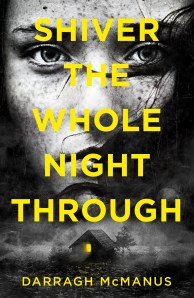
Cover me, I’m goin’ in…

Drum-roll, maestro…

Today the front cover for Shiver the Whole Night Through is officially revealed – and here it is:shiver cover

I love it. It’s spooky, evocative, Romantic with a capital r…and captures the essence of the book perfectly. Part mystery, part romance, with a little bit of horror and a chilly, wintry kind of vibe.

And yes, all the elements are relevant. It always bugs me when book covers have some totally unconnected image – a car driving into a forest, say, when there’s no mention of a forest in the text. Shiver does have a forest, though! And a girl, and a cabin…which, as you will see, plays a central role…

Anyway. You like? Feel free to let me know what you think: email darraghmcmanusATyahooDOTcom or tweet me at @McManusDarragh. I might even gather the best responses and throw them up here…


Shiver the Whole Night Through: status report

About a month ago I wrote here of how my debut Young Adult novel, Shiver the Whole Night Through, will be published by Hot Key Books in November. Figured it was about time for a status report, so…here it is.

First, the manuscript (actually a typescript nowadays, but that word doesn’t sound half so good) is finished. My editor, Naomi Colthurst, had some suggested changes from my original draft of the novel – all of which made it a better book, though of course as an egotistical writer, I didn’t want to hear this! (Also, I’m a lazy man. Work = bad.)

Anyway, I did the major rewrite earlier this year, and over the last few weeks Naomi and me have been making a few final tweaks…now we’re more-or-less done. The MS will be copy-edited as well, of course, then the laid-out book proofread a few times…ah yes, it’s all glamour, this writing game!

But the whole thing is getting quite exciting now, because we can see the completed book in sight. Already the Hot Key design people have been beavering away on a cover – from rough proofs I’ve seen, it’ll be great. Very cool and evocative; captures the mood of the book bang-on. And most importantly I guess, really leaps out at the reader from a book-shelf.

We’re also (almost) at the point of adding in acknowledgments and so on. I’ll write up a brief bio of myself – always nice to introduce yourself and your work to new readers – but I’m not a huge fan of lengthy ‘thank you’ lists in books, for a number of reasons I won’t bore you with here. It’s a mixture of personal experience and point of principle.

My last two published novels had very brief acknowledgments: Even Flow just read, ‘For Majella’ (my wife), and The Polka Dot Girl read, ‘For women everywhere.’ Simple as that. I’ll probably stick to something similar with Shiver the Whole Night Through, and hold off on the extended greetings and salutations* until I win the Oscar.

I’ve also been doing up a Spotify playlist to accompany the book – a sort of soundtrack to it. Music that inspired the book, that I listened to while writing it, that complements the story or expresses something inexpressible about the characters and themes. It’s been massively enjoyable, listening to great music for work, and a little head-wrecking too. But in a nice way. We’ll link directly to this in the e-book, and have a web address in the print edition. The music isn’t strictly necessary to enjoy Shiver, but it’s a cool little add-on, an aural embellishment.

So that’s where we stand. All I gotta do now is kick back, get slowly drunk for about four months, then rouse myself sometime in October and prep for publication. Hurray!


*That’s a quote from Heathers. If you haven’t seen it yet, rectify this immediately. The best movie ever made about teenagers. It’s 18-cert, by the way, so if you’re not yet an adult…eh, don’t let your parents catch you. I think a 15-cert would have been fine anyway, it ain’t Texas Chainsaw Massacre.


From fest to worst

‘Tis the season for music festivals, fa-la-la-la-la, la-la-la-laaah…

Unless you’re me, that is. Because I don’t go to festivals. In fact, I’ve never been to one.

Literally, not once. And that’s including the likes of Slane, which hardly counts as it’s one day. Somehow, I’ve managed to avoid attending a single festival my entire life.

This probably seems weird to you. That’s fair enough: it is weird.

Like, I’m not a hermit. I’m not in prison or incarcerated in a mental asylum – say, one of them ones off the telly where the guards are sadists and don’t let you out in the sunlight. I’m not too skint to afford a ticket. I’ve only lived abroad for four months.

And – most pertinently – I like music. I like hearing it live. I like having fun. I like meeting other human beings. I like drinking eighteen cans a day for a weekend until my brain goes into shut-down and I run around wearing a single boot, cowboy hat and maniacal grin last seen on Jack Nicholson as he smashes that door with an axe in The Shining.

Ah, good times.

All of this would suggest that festivals are ideal for me. (I don’t like camping, admittedly, but you can avoid that.) Yet I’ve never actually made it to one, and I’m not sure why.

My refusenik tendencies stretch back to the 1990s and the original “big” festival, Feile. That was also called the Trip to Tipp, which makes it even more pathetic that I didn’t attend, because I lived in Tipp. I mean, goddamn, it was just up the road.

My older siblings and some friends were rocking over to Thurles one of the days – an hour away – and tried to cajole me to come. I didn’t bother, despite the fact that a pile of my favourite bands were playing.

Instead, I flopped out on the couch, staring dully at whatever drivel was on TV and smoking fags (you were allowed smoke indoors in those days) and basically doing nothing. I presume this was the main lure of staying at home: I got to do nothing, one of my favourite things to do (or not).

Is that lazy or what? That is laaazeeee. That’s the sort of laziness you’d almost be proud of, if it weren’t so shameful.

Electric Picnic is probably the festival I most regret not attending, if only because it seems tailor-made for a pretentious media tosser like me: hip bands, vegan food, herds of poseurs, build-your-own-yurt demos, and so on.

Kraftwerk played in 2005, as did LCD Soundsystem, Goldfrapp, De La Soul. I knew they were all appearing. And I didn’t bother going.

No, scratch that: my greatest festival regret is Slane 2003. Check this out for a line-up: PJ Harvey, Queens of the Stone Age, Foo Fighters, Red Hot Chili Peppers.

Someone remind me again: why did I not go to this concert? I’d have given my right arm to see any or all of them play live. (Or your right arm, at the very least). But, as is the constant refrain of my existence…I couldn’t be bovvered.

The worst thing is, I’m now getting a bit old for festivals anyway. I know, in theory music events are for everyone, regardless of age, sex, race, creed, weight, hair colour or views on European fiscal unity vis-à-vis corporate taxation and budgetary surplus.

In reality, though, I sometimes think it looks kind of depressing, seeing some bloke shuffling around with a mob of people a decade younger than him. At best, you come across as a sad and lonely man whose kids have kicked him out of the house and he’s nowhere else to go; at worst, you could be mistaken for a leering pervert.

This is grand if you really are a leering pervert, not so good otherwise.

So remember me, when you’re boogying to The One Directionals or Paulie Nutella or whoever this summer. I’ll be at home, attending  The Festival of Tears. Acts: me. Audience: me.


Why don’t men read fiction?

Years ago I was pitching a book to an agent. He wanted more non-fiction, like my first published work; I held the common authorial prejudice that you haven’t properly made it until your fiction is in print.

He turned down my novel, and one of the reasons shocked me (even more than his inability to appreciate my genius): how little fiction is bought, despite dominating review sections. The split is an estimated 70-30 in favour of factual.

A further shock: hardly any men buy fiction. This man reckoned only about 10% of novels or story collections were purchased by blokes.

At first I didn’t quite believe this; then I got to thinking about the men I knew, specifically those who read books (sadly, not everyone does; you’d think it was part of the acceptance criteria for becoming an adult, but it’s an imperfect world).

And I realised, it’s true: most never read fiction. Some haven’t opened a novel, not one, since school.

They prefer books on history, humour, science, psychology, sociology, crime; at the fag-end of the spectrum, sports autobiographies, most of which barely count as books. Even relatively easy-to-read genre fiction – crime, fantasy, horror – is literary anathema to most men.

So great is the male aversion to fiction that you’d actually notice a man who does. Spotting a novel – any novel – on their desk, you’d almost do a double-take, maybe feel a little tingle of complicity: “This guy’s kind of like me. And we’re a small, special minority.”

Why don’t men read fiction? Nature, I think, trumps nurture. I don’t want to think that, having grown up in an era when it was assumed environment played a far greater role in shaping character than biology.

But it must be. The sexes consume more-or-less identical material as children; however chauvinist society remains, it doesn’t push little girls towards fiction and boys towards factual. Our parents read us the same fairy-tales; we study the same literature throughout school, up to adulthood.

There’s no overt pressure on teenage boys to throw away their novels. Indeed, there’s none on grown men. Nobody slags you off for reading fiction, or seems to care one way or another; they’ll just say, “Oh, I’d have no time for that.”

Yet by early adulthood, most males have lost interest in fiction. The cause, I’m sure, is genetics, neurological wiring, hormones, or some combination thereof.

Boys and men are, in general, more convergent and linear in their thinking; this would naturally draw them towards non-fiction. The most frequent male criticism of fiction is that it’s “not real”, “made-up”. Men seem to like straight narrative lines, provable facts, reportage – an architecture of external reality.

Women, by contrast, are more divergent thinkers, and also more attracted to the life of the mind: internal reality. What individuals think and feel is as important as a flat record of seismic events.

Most men are probably accurate when they say they find fiction boring: all that interior monologue, metaphor, obliqueness, tangents that don’t obviously go anywhere. And it is, by definition, invention; this never took place, they reason, so how can it mean anything?

They’re missing out on an awful lot, though – something much more profound than the accumulation of information, useful as that may be. Human culture has yet to discover a better way of capturing those moments, sensations or thoughts that happen all the time, yet paradoxically are almost inexpressible. We can’t put them in words – nobody can, not even novelists themselves – but we recognise them when somehow encapsulated by fiction, and are glad.

Noel Gallagher famously said he prefers to read about “things that actually happened” because fiction “isn’t fucking true”. But he’s wrong: real does not necessarily equate to “true” in art. Real is prosaic and quotidian; truth is universal and eternal, and so is fiction.

Oh, about that novel: several years, two agents and dozens of submissions later, it finally got published…nobody bought it.


The (few!) joys of freelancing

Contrary to presumption, freelance writing isn’t all beer and skittles. The pay is miserly, you’re never off the clock and as for the company…that gag you thought up about Eamon Gilmore’s hair, which would be hilarious in an office, isn’t so much fun when you’re telling it to yourself. Then replying to yourself.

But there are benefits to working from home: for starters you don’t have to stay there. Hop in the car anytime and go wherever you like. On a whim, I point the Batmobile north towards Gort, then north-west to Kinvara, then follow the coast south. The day is shining-fresh, sunny after rain.

The soft, shimmering light is magical, and sunshine after rain is even more so: everything looks in clearer focus, every detail super-real, like a picture doctored in Photoshop. Filter tool – sharpen – apply – save.

I haven’t taken the coast road from Ballyvaughan to Fanore in a while, and had forgotten how breath-taking this drive is. On the left, limestone hills, grey crouching giants; on the right, the great belly of the Atlantic, blue today, with splashes of green like globules of ectoplasm.

In the centre, me struggling to get my eyes off the scenery and onto the road. And appreciating the fact that instead of working, I’m driving aimlessly through the stark and beautiful Burren.

Next day, off to the woods for a run. No need to imitate those super-people who jog at 5am before beginning their day. The odds on me rising at 5am are only quantifiable by NASA supercomputer.

The fact I run at all is a minor miracle. I’m one of those folks who will never get the endorphin rush from exercise; it’s hard labour, and will forever be. But it’s necessary, and running in the woods is much more enjoyable than plodding around the roads.

You can trick yourself into thinking you’re a movie character: Jason Bourne, maybe, training between missions, or some hero in Lord of the Rings, hurtling towards death or glory. Such are the ways we delude ourselves into doing what’s best for us.

More perks of the self-employed: idling an afternoon watching hurling clips online. Normally, I can’t stand sports bores blathering on about how it contains all the answers to life, is an art-form and so on.

For all that, there are moments of real beauty and magic in sport; some of these hurlers are, almost literally, poetry in motion. What wonderful vision: when you think about the precise neurological and motor actions, how unlikely that such a subtle, sublime coalescence of mind and muscle is possible…

Yet for hurlers they’re routine. That’s the beauty of this machine we call the human being, I guess.

A final advantage of freelancing: time to write. Again, I’ll never get up at 5am to toil on a novel; working for yourself, you can find an hour here and there.

I recently finished a Young Adult story. I write YA thus: pretty much like a book aimed at adults, then take out any too-explicit references to sex, drugs or violence.

And swearing. Foul language is tricky – so tricky that I Googled, “Can you say ‘f**k’ in YA?” The feedback was inconclusive. It seems you can use minor swearwords (not too often), but the biggies – f word, c word, p word, other p word – must be sparingly, if at all.

So I spend a day going through my story, pitching the swearing at an acceptably innocent level. Change “sh*t” to “crap” a few times, replace “motherf**er” with “b**tard”, put back one of those deleted “sh*ts” for extra grittiness. Eventually, I’m happy there’s enough cussin’ to make the book sound authentic, not so much it’ll get banned by Rick Santorum if he’s ever elected.

Yes, this counts as work. Doesn’t it?


Who didst shooteth JR?

Ever wanted to read an episode of Dallas written in a Shakespearean style? More specifically, the legendary “Who shot JR?” episode of Dallas? Yeah, sure you did.

And guess what? Now you can. Players, play on…


Dallas in a Shakespearean style’

Episode title: ‘Who didst shooteth JR?’

VOICEOVER: We set our scene, forsooth, at fair Southfork, realm of the great lord, JR EWING. Alas and alack! JR hath been brought low by musket-shot. Ist he about to shuffle off this mortal coil? Find out this night on Dallas! (Sponsored by ‘Out, damn spot!’ stain remover, as used by Lady Macbeth and other homicidal celebrities.)


Enter BOBBY, SUE ELLEN and MISS ELLIE, stage left. They art dressed in Elizabethan-style pantaloons and ruff collars, which don’t go at all with 10-gallon Stetson hats. Bobby poureth a huge crystal decanter of brandy for every Christian soul present. Only then doth he notice JR’s unconscious body on the expensive Persian rug.

BOBBY: Hell’s bells! Ist this mine brother JR I see before me?

Miss Ellie screameth like witches on the moor.

MISS ELLIE: Oh, JR! Thou poor, forked creature!

SUE ELLEN: Don’t you mean ‘poor, Southforked creature’? Arf, arf.

A comical drum roll doth rise from the orchestra pit. Enter THE PRINCE (of Texas), stage right. He ist charged with doing the Lone Star state some service by discovering the knave who fireth the shot. The Prince looketh a bit like George Dubya in a crown.

THE PRINCE: Hey-nonny-nonny! What villainy ist here?

BOBBY: Your Majestic Majesty-ness, pray allow me. Mine brother JR hast been shot, though praise Jesu Christu, ist not yet dead. High alcohol levels in hist blood hath acted as some kind of preservative. God save Scotch whiskey! Hoorah!

THE PRINCE: Aye, mine CSI alchemists and necromancers doth concur. Art there witnesses to this fell deed?

A POLICE OFFICER armed with a gilt-edged sword and Kevlar jacket steps forward.

POLICE OFFICER: One fellow didst see all, my liege, but his evidence ist unusable in thine court. ‘Tis naught but a tale told by a madman, full of sound and fury, signifying nothing.

BOBBY: Yep, that’s Cliff Barnes for you.

Suddenly JR stirreth and reacheth out a hand.

JR: A horse, a horse…mine kingdom for a horse…

SUE ELLEN: Good old JR – a cowboy to the last. And I meaneth that in both senses of the word.

The Prince espies BING CROSBY’S DAUGHTER lurking offstage.

THE PRINCE: What about yon maid standing hence? She has a lean and hungry look.

MISS ELLIE: Yes, I didst thinketh ‘twas Teri Hatcher for a minute.

THE PRINCE: Come hither, wench!

Bing Crosby’s daughter enters stage left, looking as guilty as Pope Innocent X when they found out he didn’t quite liveth up to his name.

THE PRINCE: Now is the hour of my discontent. Discontent that I hath not cracked this case, that I dost resemble George Dubya, and that my crown ist starting to feel very heavy under these studio lights. Fie, woman! Give thine confession.

Bing Crosby’s daughter bursteth into a veritable river of tears.

BING CROSBY’S DAUGHTER: A pox on all your houses, ‘twas me! I didst give the rogue a belly full of lead, ha ha ha!

THE PRINCE: How cometh it to pass thusly?

BING CROSBY’S DAUGHTER: JR hath promiseth to leave Sue Ellen and marrieth me. He wast all romantic when it suiteth – ‘Oh, Bing Crosby’s daughter, shall I compare thee to a summer’s day?’ and so on. Then I discovereth he spaketh with forked tongue.

SUE ELLEN: Hey, thou art welcome to the creep. I never liketh him anyway.

THE PRINCE: Bailiff, throw yon wench into the stocks. She hath loved, not wisely but too well. Much, much too well. And now, dear friends, we must end our play in the traditional fashion.

They all stab, poison and choke each other to a bloody end.

VOICEOVER: This wast the final episode of Dallas, but make sure to tune in on the morrow for its replacement, A Midsummer Night’s Celebrity Dance-Off. A good night to all, and to all a good night!


Shiver me timbers – I’m a Young Adult author

I now stand before you as a bona fide Young Adult author. My YA debut, Shiver the Whole Night Through, will be released by UK-based Hot Key Books in November, but we made it official today.

Quick blurb: it’s the story of a bullied youngster who begins a strange relationship with the coolest girl in town – the strange part being, she’s dead. Aidan gets drawn into a dream-world of magic, desire, hope and revenge. He’s not sure if beautiful Sláine is a ghost, a demon or the figment of his imagination – but someone seems to be taking care of the bullies… Part mystery, part romance, part horror-fantasy, Shiver the Whole Night Through mixes elements of TwilightTwin Peaks, Let the Right One In, teen-detective movie Brick, and classic Gothic revenge stories.

And it’s blimmin’ great, so go pre-order fifteen copies right now.

So I’m to be published in Young Adult – which, to be honest, I never thought would happen. Let me explain.

About seven years ago I wrote an article for Declan Burke’s excellent crime-fiction blog, http://crimealwayspays.blogspot.ie/, bewailing the fact that writers are discouraged from exploring different genres. “Stick to what you’re good at,” the cry goes. (Unspoken postscript: “And what the market wants.”)

The piece moaned about how I wanted to write books of all sorts – everything from “high literature” to spoof cop stories to sci-fi dystopia to God knows what – but The System refused to let me. It wanted to pigeonhole authors. And journalism, I whined, was just as bad: many people couldn’t accept that you wanted, or were able, to write serious comment pieces and funny columns and artsy book reviews and straight interviews.

Scoot forward a few years, and I’ve brought out one non-fiction book (GAA Confidential), two crime novels (Even Flow and The Polka Dot Girl) of very different styles and types, one comic novel (Cold! Steel! Justice!!!) and now Shiver the Whole Night Through.

This list isn’t solely to blow my own trumpet – well, it is, but only a bit – it’s also to demonstrate that The System, about which I fumed so violently back then, actually isn’t so closed-off after all.

The System has now allowed me to publish books in four distinct categories, and who knows? Although Young Adult is where I’m concentrating my efforts for the foreseeable future, maybe someday I’ll take another detour, go somewhere completely new again. (That “Freddie Krueger-meets-Noddy” idea just demands to be written…)

Same in journalism: I contribute everything from “serious” think-pieces and radio reviews in the Irish Independent to book blogs in The Guardian to interviews with movie stars in the RTE Guide to a “man’s-eye view” column in U magazine to…you get the picture.

To return to that Crime Always Pays whinge-fest, this pigeon was indeed encouraged to fly. I think I owe The System an apology.

So, uh…sorry, dude. Sincerely.


  • Shiver the Whole Night Through is published by Hot Key Books in November 2014. Big thanks to editor Naomi Colthurst and all the team over there, and my agent Mildred Yuan at AP Watt @ United Agents (that’s right, I also finally got an agent after years of looking!). And to you, the (hopefully) future reader.

Kiss and (no) make up

I recently read a rather strange article in a newspaper, where the guy was commenting on that recent “No Make-up Selfie” trend. And his essential argument was: “This is a bad idea, because women don’t look good naturally, and should always wear make-up. I’m sorry, but that’s just the way it is, get over it.”

Now, it should be pointed out that the writer was a sports sub-editor, which suggests he doesn’t actually know that many women and has probably never had a conversation with one who wasn’t his mammy. Therefore his views on womankind maybe shouldn’t be taken too seriously.

It did annoy me, though. I tweeted about it: “Personally I’m attracted to women as they are, but whatever floats your boat.” For me, the fairer sex is, well, the fairer sex; yiz all don’t need to be slapping on the, uh, slap to look good.

Women look good anyway. They start from a base-level of looking good. If anything, make-up gets in the way.

Maybe some guys need a measure of cosmetic enhancement to find women attractive. I like women just fine in their natural state.

Not that I’m completely averse to make-up. I love my false eyelashes, my kohl, my hot-red lippie… Eh, that was a joke. Sort of.

I don’t mind make-up on women either. But in moderation, you know? A dusting of colour around the eyes to give that smoky, sexy, spooky vibe: good. Your skin slowly suffocating under half-an-inch of orange-coloured cement: bad.

(You stealing my false eyelashes and hot-red lippie to use for yourself: even worse. Don’t get between the D-man and his bag of beautifying tricks, I’m warning you.)

In fact, moderation is good in all things. Alcohol, exercise, licking the skull of a certain toad found in the Louisiana swamplands in order to induce narcotic euphoria and/or psychotic breakdown: whatever you fancy, it’s good to “take it handy”, as we say here in Irishland.

And when it comes to women’s appearance, moderation is even more important. Because women are always being told how to look, how not to look, do this, do that, don’t do the other. Pushed and pulled from one extreme to the next, backwards and forwards, upside-down and inside-out, until you don’t know what’s what anymore.

There’s nothing wrong with make-up, or doing your bikini line, wearing nice clothes, getting your hair did, getting your nails did, shaving your armpits, whatever you want.  (Nothing wrong with not doing any of those things either.)

But again, in moderation. Or to put it another way, to see these things as accentuating your natural beauty, maybe as little treats to make life that bit nicer, and most importantly, as something you wanted to do…not something you absolutely must do, to be complete.

It really kisses me off how women are constantly being told by advertising that there’s something fundamentally wrong with them, and how they look – but hey, thank God, our product can fix that!

Well, isn’t that a fortunate coincidence, Mr Dead-Soul Corporate Pimp. The very thing that’s disgusting and distasteful in millions of women, and you happen to be selling the “cure”.

Gah. To hell with you, Mr Dead-Soul Corporate Pimp, and how you prey on women’s insecurities to fatten your bank balance (and how you create those insecurities in the first place).

The most laughable, depressing irony of all is that the people behind this stuff are so often hideously ugly themselves. Really, genuinely horrible. I think Tom Ford is about the only designer I’ve ever seen who didn’t make me want to regurgitate last night’s half-pint of Pappy Van Winkle’s finest Kentucky bourbon.

The boss of a certain clothing chain which shall remain nameless even declared that “fat and ugly” people weren’t welcome in his store. Which, given that he resembles the rotting orc general at the Battle of Pelennor Fields, is kind of hilarious.

Now there’s a man who could do with some make-up. And when I say “some make-up”, I really mean “being entombed alive inside a lead casket”.


  • First published in U Magazine

Dear Diary…

Samuel Pepys, Anne Frank, Alan Bennett, Sylvia Plath, Andy Warhol…the list of great diarists is a long and distinguished one. The name of Darragh McManus, sadly, won’t be added to this list anytime soon.

Not because I never kept a journal – au contraire, I compulsively documented my life for several years during the 1980s. But reading back over them now, the material simply isn’t very good. And despite my overweening egomania, I fail to see why anyone would want to know about my so-called life back then.

That’s the problem with adolescent diaries, I guess: they’re self-absorbed, melodramatic, whiny, indulgent and, well, a little boring for everyone else. To be honest, they’re even boring for me to read, and I’m the main character.

Here’s a fairly typical entry: “Went to bed consumed with anger, fear and anxiety.” I didn’t note precisely what series of events had induces this hellish triumvirate of negative emotions, which was threatening to spoil my night’s sleep in March 1988; it was probably nothing, or next to nothing, and the reaction was no doubt completely disproportionate.

These journals were clearly inspired by the publishing sensation which was, and remains, The Secret Diary of Adrian Mole. Everyone at school loved that book, and half of us had promised to emulate Adrian by keeping our own.

I did so, from late 1986 to January 1990. (The entries just end, dead, at the start of the month; no explanation is given. I’m assuming this is because the Leaving Cert was looming into view, five months down the line, and obsessing over the minutiae of each pointless Groundhog Day tends to get in the way of remembering Boyle’s Law or how to decline the French verb “to listen” in six different tenses.)

Rereading old teenage diaries is funny, and cute, sometimes intriguing, often sort of disturbing. All the memories this stuff stirs up, like murky silt at the bottom of a river-bed.

I’d never realised I still hated certain people who were horrible to me back then – but apparently I do! It was almost refreshing, in a strange way, to feel that loathing swell up again, like greeting an old pal you hadn’t seen in decades. So this is all healthy and positive, right, Doctor Freud?

In a similarly strange way, I didn’t fully recognise myself in these pages. Was I really such a narky little fecker, always fighting with everybody? (And I mean everybody: parents, siblings, best friends, girls I had a crush on, God, you name it.)

Why were parts of my diary written in such a pompous style? Why had I such a nebbish fixation with statistics? (“Went to see Romeo & Juliet at The Belltable. The actors playing Romeo and Mercutio were really tall: I’d say one was about 6ft 1, the other 6ft 2½.”)

Anyway, life in the eighties, as described in these pages, was about as grey, dreary and tedious as I remembered it. One entry describes “a great day” spent mooching around shops in Limerick – not buying anything, just mooching – with the high-point a twenty-minute joyride up and down the escalators in some unnamed store.

Another wacky adventure sees me dossing the last class in school and hitting for the bus-yard where I “shared a fag with (name redacted) and threw spuds at the wall.”

Throwing spuds at the wall! No wonder I recorded all this stuff for posterity.

Ah no, it wasn’t as bad as all that. Every Halloween, for example, seemed to find me and my chums up to some harmless, but reasonably inventive, devilment: setting a carved turnip “head”, replete with candle, on the road to freak out drivers; doing likewise with a leaf-filled bag, set in the shape of a fallen body; “borrowing” bales of hay for the bonfire; goading each other to climb down into an open crypt in the graveyard; setting off illegal, finger-endangering bangers which (name redacted) had sourced in France somewhere…

Ugh. Okay, I lied. Except for Halloween, it was as bad as all that.

Still, this stuff will be put to good use. The reason I’m rereading the diaries is as prep for a story I’m writing, which is set in the 1980s. And in the novel-memoir crossover style currently à la mode, I’ll be basically regurgitating real events, thinly disguised as fiction, to save myself the bother of having to make things up.

So good news, bullies of the past: if you were mean to me in school, I’m about to make you famous…


  • First published in the Irish Independent